
Company Retreat, Team Building or Incentive Trip? How to Choose the Right Corporate Travel Format
Company retreat, team-building trip, incentive trip, strategic offsite or conference? Learn which corporate travel format fits your goal: from team connection and strategy to employee motivation and rewards.
COMPANY EVENTS
ELEMENTS COMPANY

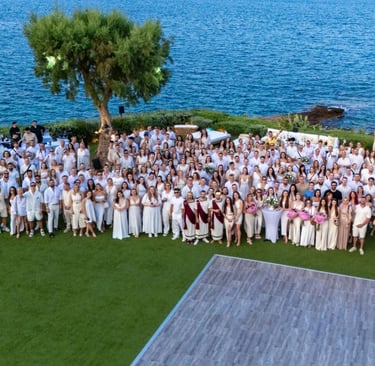
Planning a company trip abroad? Start by defining what you actually want to achieve. A company retreat, team-building trip, incentive trip, strategic offsite or conference each serves a different purpose — and the programme should be built around it.
When companies start planning a trip abroad, they often begin with the destination.
Where should we go? Somewhere by the sea? Greece? Crete? A European city?
We think there is a more important question to ask first:
What do you want this trip to achieve for the company and the people going on it?
Should people come back feeling more connected?
Do you want to reward your best performers?
Do you need a few focused days to work on strategy?
Do you want to communicate a new direction to the whole company?
Or do you need a combination of several of these things?
Only once you know the answer does it make sense to decide whether you need a company retreat, team-building trip, incentive trip, strategic offsite, meeting or conference.
The programme and destination come afterwards.
Quick answer: Which type of company trip should you choose?
In simple terms:
you want to strengthen relationships and connect the team → company retreat / team-building trip
you want to reward employees → incentive trip
you want to work on strategy or a specific business topic → strategic offsite / meeting
you want to communicate information to a larger group → conference / company meeting
you want to achieve several objectives at once → combine different formats
The name of the trip is not the most important thing.
Its purpose is.
1. Company retreat or team building: when the goal is stronger relationships
A company retreat or team-building trip makes the most sense when the main objective is to strengthen relationships.
And not only relationships between employees, but also the relationship employees have with the company itself.
The goal might be to:
connect a remote or hybrid team
bring different departments together
introduce employees from different countries
improve collaboration
strengthen company culture
create a stronger sense of belonging
give people a shared experience outside the office
A company retreat or team-building trip will typically involve the whole company, a department or a larger part of the team.
What should the programme look like?
If the aim is to connect people, there is no need to force them through artificial team-building exercises.
Quite the opposite.
People often build stronger relationships when they simply experience something together in a natural way.
During a company trip abroad, that might mean:
a boat trip
an excursion
a local food experience
a hike
a cultural experience
dinner together
exploring the destination
activities that naturally mix people into different groups
Imagine a remote team whose members mainly know each other through Teams or Slack.
The goal does not have to be completing ten scheduled activities.
It may simply be:
bringing everyone together for a few days and creating enough space for them to start functioning as a real team.
2. Incentive trip: when the main objective is reward
Team-building trips and incentive trips are sometimes confused.
But there is an important difference.
Team building is primarily about the team. An incentive trip is primarily about reward.
An incentive trip will not usually include the entire company.
Participants are selected according to predefined criteria.
They might be:
top salespeople
top performers
the best-performing team
winners of an internal competition
employees who have achieved specific targets
selected key employees
An incentive trip can therefore become part of a company's non-financial reward and employee motivation strategy.
For example, a company could decide:
“Every quarter, our five top performers go on a short incentive trip abroad.”
Or it could organise one larger incentive trip each year.
What should an incentive trip include?
If the trip is meant to be a reward, it should genuinely feel like one.
That might mean:
high-quality accommodation
experiences people would not normally organise for themselves
great food
private experiences
minimal logistical stress
as little mandatory work as possible
At ELEMENTS COMPANY, for example, we run a long-term incentive project for small groups of three to four top-performing employees.
They come to Crete for just two nights, with one intensive full day of experiences in between.
For a typical company retreat, we would not usually recommend such a short stay.
For a small incentive group with a very clear purpose, however, it works extremely well.
Not sure how long your company trip should be? Read our guide to choosing the right length of stay.
3. Strategic offsite or meeting: when the priority is work
If the trip has a primarily business objective, there is no reason to turn it into a traditional team-building event just because everyone is travelling.
Sometimes a company simply needs to take a small group away from day-to-day operations and create space for:
strategic planning
leadership meetings
developing a new strategy
making important decisions
brainstorming
working on a new product
solving a specific project or business challenge
In this case, a strategic offsite or focused working meeting may be the right format.
It usually works better with a smaller group.
Five or ten people can work intensively together in a way that fifty people simply cannot.
The change of environment still has value.
People are away from their normal operational distractions, phones and everyday office routine.
They can focus on topics that rarely get enough time during a normal working week.
4. Conference or company meeting: when the priority is communication
With a larger group, the primary goal may be to communicate information.
For example, you might need to:
introduce a new strategy
communicate company changes
present results
launch a new product
bring several offices or markets together
explain where the company is heading next
In that case, the main format may be a conference, company meeting or internal corporate event.
Unlike a strategic offsite, you do not necessarily need fifty people to solve one problem together.
You need everyone to hear the same message at the same time and from the same source.
And this format makes it very easy to add a second objective.
For example:
morning conference → afternoon shared experience → dinner together
The company communicates important information while also strengthening relationships.
5. Different formats can be combined
In reality, a company trip does not have to fit neatly into one category.
Very often, combining several objectives makes the most sense.
Perhaps you want to:
connect the team + work on strategy
Most of the retreat can focus on shared experiences, while management takes two hours one morning for a strategic session.
The key conclusions can then be presented to the wider team afterwards.
Or perhaps you want to:
inform employees + strengthen relationships
The first part of the day can be a conference, followed by a shared experience in the afternoon.
Or:
reward employees + encourage team bonding
The trip can be designed primarily as an incentive, while the shared experiences naturally strengthen relationships between participants at the same time.
This is exactly why defining the objective matters before selecting individual activities.
6. Group size changes what is possible
The number of participants is another important factor.
A smaller group
For example, 5–10 people.
This works particularly well for:
incentive trips
leadership retreats
strategic offsites
intensive working sessions
more premium or exclusive experiences
Small groups are more flexible.
They are easier to move around, book into venues and restaurants, adapt the programme for and work together effectively.
A medium or large group
For example, 30, 50 or 100 people.
These groups can work well for:
company retreats
team-building trips
conferences
all-company meetings
combinations of shared activities and smaller workshops
Fifty people are unlikely to have one productive strategic discussion together.
But a strategy presentation followed by smaller breakout groups can work extremely well.
Group size therefore changes more than logistics. It changes what the trip can realistically achieve.
7. A company trip can be a one-off or a recurring format
Not every corporate trip needs to be a one-time event.
A company can build recurring travel formats into the way it operates.
For example:
an annual company retreat for the whole team
a quarterly incentive trip for top performers
an annual leadership offsite
a recurring conference for several offices or markets
This can create an additional benefit.
International company trips can gradually become part of the company culture and employer brand.
If a potential employee knows that the company takes its team abroad every year or regularly rewards top performers with international experiences, that can influence how they perceive the employer.
It can also strengthen the relationship existing employees have with the company.
This should not be the main reason for organising the trip.
But it can be a valuable additional effect.
The most important question: What should be different when people return?
If you are unsure which type of company trip to choose, ask one simple question:
What do we want to be different when everyone comes back?
Do we want people to:
know each other better?
feel more connected to the team?
feel more motivated?
feel proud of the company they work for?
understand the new strategy?
know where the company is heading?
have made specific management decisions?
feel that their performance has been recognised?
The answer will usually point you towards the right format.
Purpose first. Then format, programme and destination.
Company trips often start with the question:
“Where should we go?”
We would reverse the process:
1. What should the trip achieve?
2. Which format supports that objective best?
3. What programme will help achieve it?
4. Which destination is best suited to that programme?
Because the same destination can serve completely different purposes.
Crete can be:
a company retreat for a remote team
a team-building trip for an entire department
a short incentive trip for five top performers
a strategic offsite for management
an internal conference combined with shared experiences
The destination can stay the same. The reason for travelling changes everything else.
FAQ: Company Retreat, Team Building, Incentive Trip or Offsite?
What is the difference between a team-building trip and an incentive trip?
A team-building trip is primarily designed to strengthen relationships between employees and their connection to the company. It will typically include the whole team or department. An incentive trip is a reward for a selected group of people who have met predefined performance or other criteria.
What is the difference between team building and a company retreat?
The terms can overlap. A company retreat is generally a broader, multi-day format that may combine team building with work, strategy sessions, downtime and other shared experiences.
When does a strategic offsite make sense?
When the main objective is to work, make decisions or create dedicated space for strategic topics. Strategic offsites usually work best for smaller groups such as management or a specific project team.
When should you organise a conference or company meeting?
When the primary goal is to communicate information to a larger number of employees — for example a new strategy, company results, a product launch or the future direction of the business.
Can you combine a conference and team building?
Yes. For example, the morning can be dedicated to presentations or working sessions, followed by a shared experience in the afternoon. Combined formats are common and often make the most sense.
Does the whole company need to attend an incentive trip?
No. In fact, incentive trips are often specifically designed for a selected group of employees based on performance or other predefined criteria.
Should you choose the destination or the purpose of the trip first?
We recommend defining the purpose first. Once you know what the trip needs to achieve, you can choose the right format, length, programme, group size and destination.
Planning a Company Trip Abroad?
You do not need to know in advance whether you need a company retreat, team-building trip, incentive trip or strategic offsite.
Simply tell us:
who is travelling, why you are organising the trip, what you want to be different when everyone returns and your approximate budget.
At ELEMENTS COMPANY, we use that to design the right format, length of stay, programme and overall trip.
We do not start with the destination.
We start with the reason you are travelling.
